
An opinion piece for formulators, procurement leads, and brand owners weighing where the concentrated-cleaning category goes next.
- Thesis: Cleaning tablets have crossed from novelty to shelf staple, but brands leaning only on sustainability messaging are misreading what the modern buyer rewards.
- Formulation is the battleground. Dissolution behavior, cleaning power, and stability now decide reorders far more than the eco-badge on the box.
- Packaging is a system, not a claim. A "plastic-free" label means little if the moisture barrier or outer wrap quietly reintroduces plastic.
- Regulation is setting a floor. EU packaging waste rules, retailer ESG scorecards, and GHS labeling are shaping specs whether brands are ready or not.
- Contrarian caution: Convenience still wins the mass shopper. Tablets succeed where the application forgives a short dissolve delay — not everywhere.
The Thesis: Tablets Aren't a Fad, But "Green" Won't Carry Them Alone
Let me stake out a position early, because the category deserves a direct one. Cleaning tablets are no longer a curiosity for eco-forward early adopters. They are becoming a durable format across surface sprays, toilet care, laundry, and dishwashing.
But here is where I part ways with much of the industry chatter: brands treating sustainability as the whole pitch are setting themselves up to lose. The buyer who tries a tablet because it's plastic-light will only repurchase if it actually cleans, dissolves cleanly, and doesn't crumble in a humid bathroom.
This article argues that the winners will pair a credible environmental story with provable performance and reliable supply. Formulators, procurement teams, and brand owners evaluating the space should read the next few years as a performance race, not a marketing one.
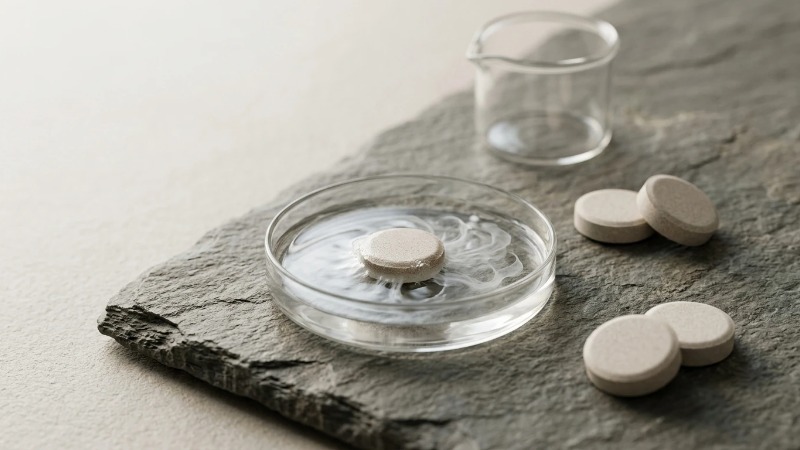
Why the Cleaning Tablet Conversation Got Serious
Ready-to-use bottles are mostly water shipped across oceans. Once freight costs spiked and plastic regulation tightened, that math stopped making sense for a growing slice of the category. Waterless concentrated cleaning tablets solved several problems at once — lighter freight, smaller carbon footprint per unit, and a story retailers could put on a shelf talker.
Retailer mandates did the rest. When large chains started scoring suppliers on packaging and lifecycle impact, concentrated formats moved from "nice to have" to "get us a line."
From Gimmick to Gondola Space
The arc is worth tracing. The first wave was direct-to-consumer refill brands with clever branding and a subscription hook. They proved demand existed and educated a niche of shoppers on the "add water, don't buy water" idea.
The second wave is happening now, quieter and more consequential — mainstream private label listings in mass retail. That's a different game. It demands consistent quality at volume, not a viral launch.
What Actually Changed for Manufacturers
Here's the part the marketing decks skip. A tablet isn't just a reformulated liquid. It changes tooling, compression pressure, drying, humidity control on the line, and the entire packaging approach.
Effervescent formulas are hygroscopic and will react to ambient moisture before they ever reach a consumer. Getting a tablet program right is as much a process-engineering challenge as a chemistry one, and manufacturers who underestimate that ship product that falls apart in transit.
Trend 1: Formulation Is Where the Real Competition Sits
My strongest conviction: the differentiator is migrating from packaging back to the formula. Early brands competed on aesthetics and refill convenience. The next cohort competes on how well the thing performs the third time you use it.
Effervescent vs. Compressed Dissolution
Two tablet architectures dominate, and they suit different jobs. Effervescent tablets fizz apart quickly, which makes them ideal for sprayer refills and multi-surface cleaners where the user wants a fast, complete dissolve.
Compressed tablets release slowly, which is exactly what a toilet bowl or dishwasher application wants. Choosing the wrong architecture for the use case is a common and expensive mistake.
The Biodegradable Formula Balancing Act
Biodegradable cleaning tablet formulas involve real trade-offs, and I'd rather be honest about them than sell a fantasy. Surfactants and builders that meet OECD-referenced ready-biodegradability criteria don't always match the raw cleaning punch of conventional actives.
You can close much of that gap with smarter enzyme systems and chelant substitutions, but "close" isn't "identical" for every soil type. A serious supplier will tell a brand where the compromise lands rather than pretend it doesn't exist.
| Format | Best-fit application | Typical dissolve behavior | Key formulation challenge |
|---|---|---|---|
| Effervescent | Sprayer refills, multi-surface | Fast | Stability / moisture ingress |
| Compressed | Toilet, dishwasher | Slow release | Binder selection |
| Coated / multi-layer | Timed-action cleaners | Variable | Cost & tooling complexity |
Dissolve behavior above is directional; actual times shift meaningfully with formula, tablet mass, and water temperature, so treat these as categories rather than fixed figures.
Trend 2: Packaging Moves From Plastic-Free Claim to Provable System
Refillable cleaning tablet packaging and plastic-free cleaning solutions get pitched as a label. They're actually a systems problem, and that distinction separates credible programs from greenwash.
The Refill Loop Retailers Will Actually Stock
A durable dispenser plus a stream of refills only works if the unit economics hold. The first purchase carries the cost of the bottle; every refill after that has to feel like a saving to the shopper and a margin to the retailer.
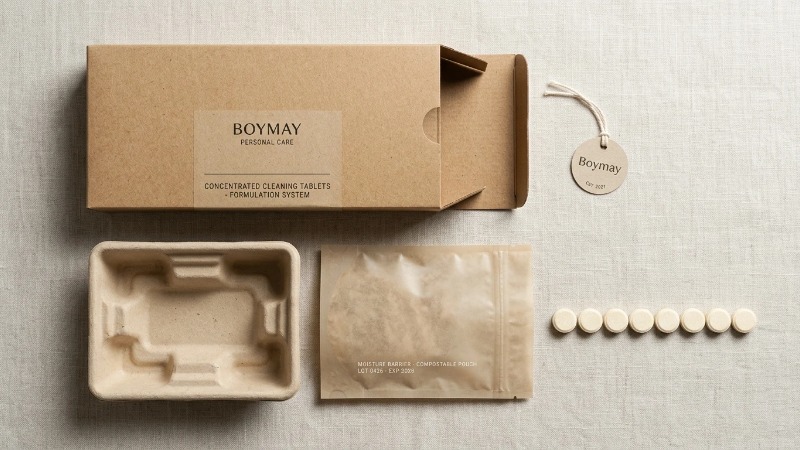
And here's the uncomfortable detail I see repeatedly — a brand markets "plastic-free," then wraps the tablet in a plastic-lined sachet to fight moisture. The primary bottle went away; the plastic just moved. Buyers and regulators are getting sharper about spotting that.
Barrier Materials and the Moisture Problem
Tablet shelf life lives or dies on the barrier. Eco-friendly cleaning tablets ask a lot from compostable films and paper-based wraps, because those materials generally offer weaker moisture protection than the multilayer plastics they replace.
The engineering answer usually blends formulation and packaging — a more moisture-tolerant tablet paired with a realistically achievable barrier, sized to a distribution window the brand can actually manage. Anyone promising a fully compostable wrap with a two-year humid-climate shelf life should be asked hard questions.
Trend 3: Regulatory and Retailer Pressure Is Setting the Floor
By 2026 the specs aren't being written by marketing anymore — they're being written by compliance. EU packaging and packaging waste rules are pushing recyclability and recycled-content thresholds. Retailer ESG scorecards translate those pressures into vendor requirements. GHS classification and labeling govern how concentrated actives get communicated and shipped.
I won't attach invented percentages to any of these, because the exact thresholds move and vary by jurisdiction. The trend direction, though, is not in doubt: the regulatory floor is rising, and it favors suppliers who already build to it.
What North American, EU, and Middle East Buyers Ask For
From working across these B2B markets, the questions differ by region in ways worth naming. North American buyers tend to lead with performance benchmarks and cost-per-use, then ask about claims substantiation.
European buyers open with lifecycle and packaging compliance almost immediately. Middle East buyers frequently weight fragrance profile, appearance, and stability under high ambient temperatures — a genuine formulation constraint that a temperate-climate spec can quietly fail.
Expert Perspective
"The brands that call us second — after their first tablet launch cracked or clumped — always underestimated humidity control on the line. They optimized the recipe and treated packaging as an afterthought. In this category, process and pack are the recipe."
— A contract-manufacturing formulation lead
"Retail buyers stopped accepting 'plastic-free' at face value about two seasons ago. Now they want the whole packaging system documented, wrap included. A vague claim is a liability, not a selling point."
— A private-label procurement specialist
The Counterargument, Taken Seriously
It would be dishonest to argue the bull case without steelmanning the skeptics, so here's their strongest version.
"Tablets Are Overhyped and Consumers Revert to Convenience"
The skeptic's case is real. Waiting for a tablet to dissolve is friction, and friction loses to grab-and-spray convenience for the mass shopper. Dosing errors — wrong water volume, half-dissolved residue — generate bad first impressions. And the premium price of some refill systems meets stiff resistance once the novelty fades.
Rebuttal: Where the Skeptics Are Right, and Where They're Not
They're right that tablets won't universally replace liquids, and any forecast claiming otherwise is overreaching. Convenience is a durable human preference, not a bug to be marketed away.
But the doubt overshoots. Dissolve friction barely matters for a toilet tablet or a dishwasher application where the user isn't standing there waiting. Dosing errors shrink with better tablet-per-bottle ratios and clearer instructions. The category doesn't need to win everywhere — it needs to win the applications where its trade-offs are invisible, and there it's fundamentally sound.
What This Means for Brands and Manufacturers
Practical implications, then. If you're evaluating a private-label tablet program, treat the manufacturing partner as a formulation and process partner, not a filler.
Ask about humidity-controlled production, compression tooling, and stability testing before you ask about price. Confirm realistic MOQs — a credible OEM/ODM partner can start meaningful runs from around 1,000 units, which lets you test the market without committing to a warehouse of unproven inventory.
Plan the calendar honestly. Custom sample development typically runs 7–14 days depending on formula, fragrance, appearance, and packaging complexity, with bulk production commonly landing in a 25–30 day window. Custom molds and multi-layer coatings add tooling lead time, so scope those early rather than discovering them mid-launch.
Conclusion: Bet on Performance-Backed Sustainability
So here's my closing position, unchanged from the top but now earned. Cleaning tablets are a real, growing format — and the brands that thrive will refuse to treat sustainability and performance as a choice. They'll deliver both, backed by supply they can actually count on.
The eco-claim gets a shopper to try once. The formula, the dissolve, and the stability decide whether they ever buy again. If you're allocating budget or shelf space in this category, the question worth sitting with is simple: does your tablet program still make sense the day the "green" novelty wears off?

Ready to Build a Tablet Program That Holds Up?
If you're a brand or retailer evaluating the concentrated-cleaning category, we'd welcome a technical conversation about OEM/ODM development, custom formulation, biodegradable options, and sampling. With decades of private-label manufacturing experience, certified production, and low starting MOQs, it's a low-friction way to pressure-test the opportunity before you commit. Reach out to discuss your formulation, packaging, and timeline requirements — and get a realistic answer, not a sales pitch.
FAQ
Q: Are cleaning tablets actually more sustainable than liquid cleaners?
A: Often, but not automatically. Tablets cut shipped water and packaging weight, which lowers freight emissions per use. The real gain depends on the refill system, the barrier material, and whether the outer wrap reintroduces plastic — a full lifecycle view matters more than the headline claim.
Q: What shelf life can a compressed cleaning tablet realistically achieve?
A: It varies with formula and packaging, but the limiting factor is almost always moisture protection rather than the actives. A well-formulated compressed tablet in an appropriate barrier can hold up through a normal retail cycle; aggressive humid-climate distribution shortens that window, which is why regional testing matters.
Q: What's a typical minimum order for a private-label tablet program?
A: Reputable manufacturers can begin custom tablet programs from around 1,000 units, allowing brands to validate demand before scaling. Lower MOQs make it practical to launch, gather real reorder data, and refine the formula before committing to volume.
Q: How long does custom sample development usually take?
A: Generally 7–14 days, depending on how complex the formula, fragrance, appearance, and packaging requirements are. Timed-action or multi-layer tablets sit at the longer end because they involve additional tooling and testing.
Q: Do biodegradable formulas clean as well as conventional ones?
A: For many everyday soils, modern biodegradable cleaning tablet formulas perform competitively, particularly with well-chosen enzyme systems. For the toughest soils, there can still be a modest performance gap — a trustworthy supplier will tell you where that line falls for your specific application instead of overselling parity.