
If you're deciding how to bring aromatherapy shower steamers to market, the first fork in the road isn't fragrance or packaging — it's the sourcing model. White label and private label pull your budget, your launch date, and your brand's long-term defensibility in different directions. This guide walks buyers, brand managers, and procurement teams through both, with the manufacturing realities that rarely make it into a supplier's sell sheet.
Quick Answer: White Label vs. Private Label in One Minute
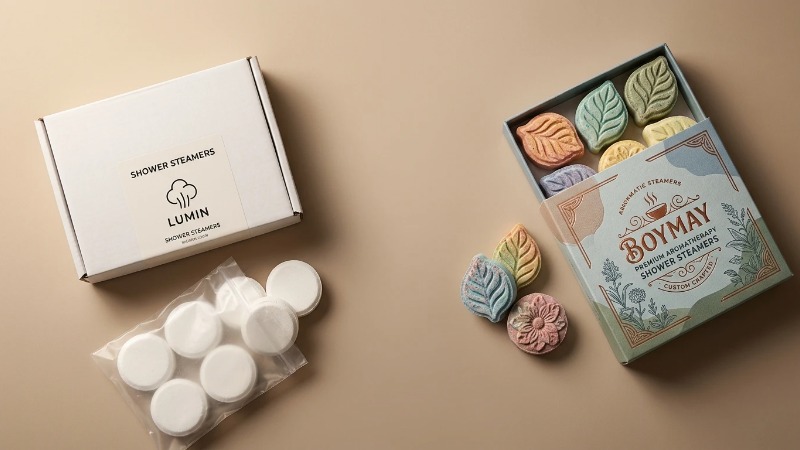
White label means you take a supplier's ready-made shower steamer formula and sell it under your own logo and label. The same recipe may sit on a competitor's shelf. Private label means the product is built to your specification — formula, fragrance, active ingredients, mold shape, and packaging — so it belongs to your brand alone.
Choose white label if you need speed, a small first order, and a low-risk way to test the category. Choose private label if differentiation, margin control, and a distinct scent identity matter more than shaving a few weeks off launch.
Why the White Label vs. Private Label Decision Matters
This one call shapes everything downstream. A white label buy gets you to shelf quickly with minimal capital tied up. A private label program costs more upfront and takes longer to set up, but it hands you a product no one else can copy line-for-line — which is where repeat purchase and pricing power come from.
Shower steamers are a scent-led purchase. Buyers rebuy because a eucalyptus-menthol blend cleared their sinuses on a rough morning, not because the box looked nice. When the formula is the product, owning that formula is owning the brand.
Where Shower Steamers Sit in the Personal Care Market
Shower steamers grew out of the bath bomb boom, and they've carved out their own lane for people who shower rather than soak. Demand skews toward essential-oil blends — eucalyptus, peppermint, lavender, citrus — with menthol for that cooling "vapor" hit.
Two buyer expectations have hardened in North American, European, and Middle Eastern retail: vegan formulation and no animal testing. Retail buyers increasingly ask for proof, not just a claim on the label. Treat cruelty-free and vegan positioning as table stakes, not a selling point.
Core Definitions: Getting the Terminology Right
Buyers conflate these terms constantly, and vague terminology leads to mispriced quotes and mismatched expectations. Here's the precise version.
What Are White Label Shower Steamers?
A white label steamer is a generic, pre-developed product the manufacturer already makes at scale. The supplier owns the formula. Your involvement is limited to logo, label artwork, and sometimes carton choice. It's the fastest route to shelf and the lowest barrier to entry.
What Are Private Label Shower Steamers?
A private label steamer is made to order under a manufacturer's OEM/ODM program. You control the formula, fragrance profile, active ingredients and their strength, the shape and mold, and the full packaging system. The result is proprietary to your brand.
White Label vs. Private Label vs. OEM/ODM
These labels overlap, which is where confusion starts. Think of private label as the umbrella. Underneath it, OEM (Original Equipment Manufacturer) means the factory builds to your spec and your recipe. ODM (Original Design Manufacturer) means the factory develops the product design and formula, then lets you brand it as your own.
White label is closest to a stripped-down ODM: supplier-designed, buyer-branded, but shared across multiple clients rather than exclusive to you.
Side-by-Side Comparison Table
| Factor | White Label | Private Label (OEM/ODM) |
|---|---|---|
| Customization level | Logo and label only | Formula, fragrance, actives, mold, packaging |
| Formula ownership | Supplier owns it (shared) | Buyer's spec; exclusive to your brand |
| Typical MOQ | Lower entry; small test runs | From ~1,000 units per SKU |
| Unit cost | Lower per unit | Higher, but scales down with volume |
| Time to market | Fastest | Longer setup, then repeatable |
| Sampling | Existing samples off the shelf | Custom samples in ~7–14 days |
| Differentiation | Thin — same product elsewhere | Strong — proprietary scent and shape |
| Typical buyer | Startups, category testers | Scaling and established brands |
Deep Dive 1: Customization and Product Control
Control runs on a spectrum. White label gives you almost none below the label; private label opens up every layer. Here's what each layer actually involves.
Formula, Fragrance, and Actives
This is the heart of the product. In a private label program you specify the essential-oil blend, the menthol load (a light cooling effect versus an aggressive vapor rush is a real formulation decision), colorants, and whether the base is fully vegan.
Fragrance load matters more than newcomers expect. Push essential oils too high and you risk a steamer that crumbles or fades on the shelf; too low and it underperforms in the shower. Owning that balance is what protects your brand equity over time — a white label buyer can't tune it.
Shape, Mold, and Appearance
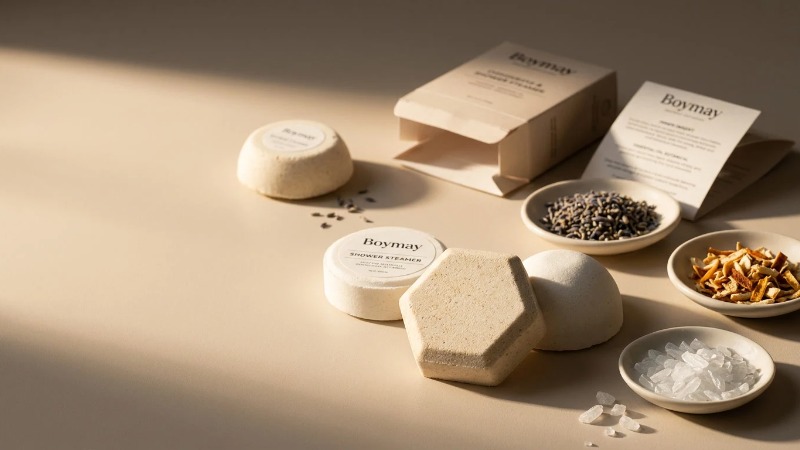
Standard shapes — discs, domes, hexagons — keep tooling costs at zero and get you moving fast. A custom mold costs more and adds lead time, but a proprietary shape is a visual signature competitors can't legally replicate. For a brand building shelf recognition, that's often worth the tooling investment.
Packaging, Labeling, and Compliance Marks
Retail-ready presentation covers the carton, inner inserts, protective wrap, and any certification callouts on-pack. This is also where you should verify — not assume — that the factory holds current GMP, ISO, FDA, and SMETA credentials. A steamer sold in a US retailer faces different labeling scrutiny than one going to an EU or Gulf distributor, and your manufacturer should already know those differences.
Deep Dive 2: Cost, MOQ, and Margin Economics
The financial trade-off is straightforward once you separate unit cost from total commitment.
Unit Cost and Volume Breakpoints
Three things push unit cost up: customization depth, fragrance load, and packaging complexity. A plain steamer in a simple carton is cheap; a custom-molded steamer with a heavy essential-oil blend and a rigid retail box is not.
Volume works in your favor. As order quantity climbs, fixed costs — tooling, setup, QC — spread across more units, and the per-piece price drops. This is why an established retailer's private label economics beat a startup's white label economics at scale.
MOQ Realities for Each Model
- White label: lower minimums suit a first test or a seasonal one-off. You trade exclusivity for a smaller commitment.
- Private label: custom programs commonly start around 1,000 units per SKU. That's the threshold where dedicated formulation and tooling become viable for both sides.
If a supplier quotes a custom program with a suspiciously low MOQ, ask what corners get cut — it usually means a semi-stock formula wearing a "custom" label.
Deep Dive 3: Speed to Market and Scaling
Timelines decide whether you make a seasonal window. Plan backward from your on-shelf date.
Sampling and Approval Timelines
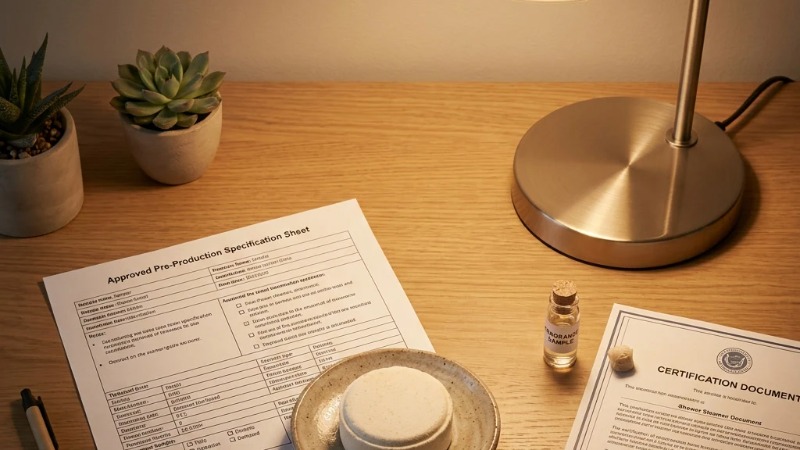
For custom work, expect sample turnaround of roughly 7–14 days, depending on formula complexity, fragrance sourcing, appearance, and packaging. Never skip this step. A pre-production sample is your one chance to catch a scent that reads differently in water or a color that bleeds.
Production Lead Times and Reorders
Once a sample is approved, bulk production typically runs 25–30 days. Build that into your reorder cadence so you don't run dry during a sell-through spike. For seasonal peaks — cold-and-flu season pulls eucalyptus and menthol steamers hard — place reorders before you can see the shortage coming, not after.
Pros and Cons of Each Model
White Label — Pros and Cons
| Advantages | Limitations |
|---|---|
| Fastest route to shelf | No exclusivity — shared formula |
| Low entry cost and small minimums | Thin differentiation from rivals |
| Low risk for category testing | Little to no formula control |
Private Label — Pros and Cons
| Advantages | Limitations |
|---|---|
| Real differentiation and brand fit | Higher MOQ commitment |
| Formula and design ownership | Longer initial setup |
| Better margin control at volume | More upfront involvement required |
How to Choose: A Decision Framework
Match the model to where your business actually is — not where you hope it'll be next year.
Match the Model to Your Business Stage
If you're a startup or testing whether steamers belong in your assortment, white label lets you validate demand without locking up capital. If you're scaling, or an established brand where consistency and a signature scent drive repeat sales, private label is the move. Some brands sensibly start white label and graduate to private label once the numbers justify tooling.
Questions to Ask a Manufacturer Before You Commit
- Which certifications do you hold, and can you share current documents? (GMP, ISO, FDA, SMETA)
- What's your factory footprint, line count, and staffing? Can it absorb my reorders?
- What's your sample policy, cost, and turnaround?
- How flexible is MOQ across SKUs?
- Can you prove vegan and cruelty-free formulation, not just claim it?
- What's your in-process and final QC procedure?
Common Mistakes and Best Practices
Mistakes Buyers Make When Sourcing Shower Steamers
The recurring ones: treating compliance as an afterthought, underestimating fragrance stability over a product's shelf life, skipping the pre-production sample to save two weeks, and over-ordering an unproven SKU before demand is confirmed. Each is avoidable and each is expensive.
Best Practices for a Reliable Supply Partnership
Audit certifications yourself rather than trusting a logo on a website. Always request and approve a pre-production sample. Confirm reorder timelines in writing before your first order sells through. And validate factory scale — square footage, automated lines, headcount — because a partner that can't grow with you becomes a bottleneck at exactly the wrong moment..
Conclusion and Next Step
The core trade-off never really changes: white label buys you speed and low risk; private label buys you differentiation and control. Match the model to your stage, verify your manufacturer's credentials and capacity, and never launch on an unsampled formula.
Ready to Develop Your Shower Steamer Line?
If you're planning a private label or OEM/ODM program, work with a manufacturer that backs it up — GMP, ISO, FDA, and SMETA certification, low MOQs from 1,000 units, custom molds and vegan formulations, samples in 7–14 days, and stable 25–30 day production. Request a quote or a custom sample today, and get your shower steamer line moving from concept to shelf with a partner built for it.
Frequently Asked Questions
Q: Is private label more expensive than white label?
A: Upfront, yes — private label carries tooling, formulation, and higher minimums. Per unit at volume, the gap narrows and can reverse, and the exclusivity and margin control often justify the difference for a serious brand.
Q: What is a typical MOQ for custom shower steamers?
A: Custom private label programs commonly start around 1,000 units per SKU. White label test runs can be smaller, in exchange for a shared, non-exclusive formula.
Q: How long do samples and bulk production take?
A: Custom samples typically take 7–14 days depending on formula, fragrance, appearance, and packaging. Bulk production usually runs 25–30 days after sample approval.
Q: Can shower steamers be made vegan and cruelty-free?
A: Yes. Reputable manufacturers offer vegan formulations and do not test on animals. Ask for supporting documentation so the claim holds up under retailer and regulatory scrutiny.
Q: Which model is better for a new brand vs. an established retailer?
A: New brands and category testers usually start with white label to limit risk. Established retailers and scaling brands lean private label for differentiation, ownership, and better economics at volume.