
Demandez à tout responsable expérimenté des approvisionnements ce qu’il vérifie en premier lorsqu’il évalue un nouveau fabricant de savons, et la réponse concerne rarement le prix ou les profils de fragrance. Il s’agit de la quantité minimale de commande. Le MOQ détermine discrètement le montant de capital immobilisé, la rapidité avec laquelle vous pouvez tester un marché et la pertinence même d’un suivi par e-mail.
Pour les acheteurs du secteur des savons artisanaux et des soins personnels, comprendre le MOQ n'est pas une simple formalité—c'est le cadre qui détermine l’ensemble de votre stratégie d’approvisionnement. Ce guide explique comment les minimums fonctionnent réellement, ce qui les fait augmenter ou diminuer et comment les adapter à la situation actuelle de votre entreprise.
Comprendre le MOQ dans la fabrication de savons artisanaux
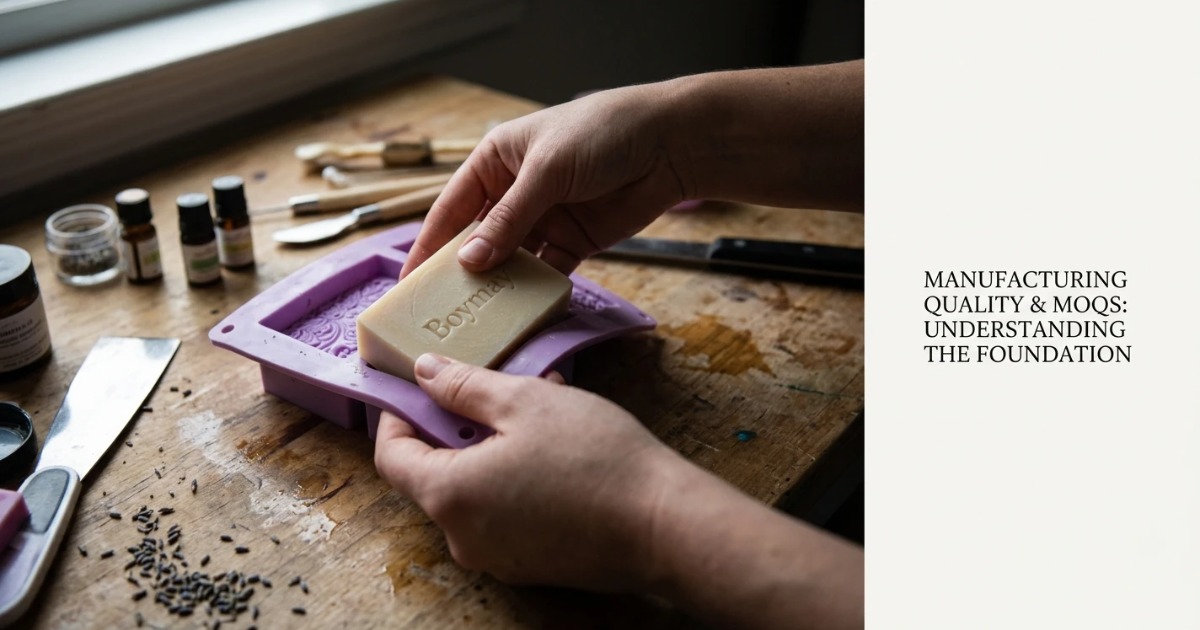
Que signifie réellement le MOQ ?
La quantité minimale de commande en gros de savons artisanaux correspond au plus petit lot qu’un fabricant produira pour une seule commande. Cela paraît simple—jusqu’à ce que l’on réalise qu’il en existe deux versions.
Le MOQ par SKU s’applique à chaque variante de produit distincte (un parfum, une couleur ou une forme spécifique). Le MOQ par commande regroupe tous les produits dans un même seuil. Lorsqu’une usine indique "1,000 unités minimum", cela peut signifier 1,000 unités par SKU ou 1,000 unités pour l’ensemble de votre commande. Cette distinction peut faire varier votre première commande d’achat de dizaines de milliers de dollars ; il est donc essentiel de toujours la faire confirmer par écrit.
Pourquoi les fabricants fixent-ils des MOQ ?
Les MOQ ne sont pas des obstacles arbitraires. Ils reflètent les réalités économiques de la production. Les matières premières—huiles, soude caustique, extraits botaniques, composés parfumés—sont achetées en gros, et les fournisseurs acceptent rarement de réduire leurs minimums pour les petites séries.
Il faut également prendre en compte la préparation : nettoyage et reconfiguration des équipements de mélange, étalonnage des moules et affectation de la main-d’œuvre qualifiée. Une petite série répartit ces coûts fixes sur un nombre d’unités trop limité, ce qui rend la production non rentable. Les lignes automatisées accentuent ce phénomène—elles sont efficaces à grande échelle, mais coûteuses lorsqu’elles restent inactives pour de petits lots.
Fourchettes de MOQ courantes dans le secteur
Les ateliers-boutiques spécialisés dans la saponification à froid acceptent parfois 100–300 unités, mais avec des tarifs par pièce plus élevés. Les usines OEM de taille intermédiaire commencent généralement autour de 1,000–3,000 unités par SKU. Les grands sites de production qui ciblent les contrats avec les chaînes de distribution ne discuteront souvent pas de volumes inférieurs à 10,000 unités.
Le niveau de MOQ d’un fournisseur en dit long sur les entreprises auxquelles il s’adresse. Un seuil de 1,000 unités indique un fabricant habitué à travailler avec des marques émergentes et des détaillants de taille intermédiaire—et pas uniquement avec des comptes multinationaux.
Facteurs qui influencent le MOQ de vos savons
Niveau de personnalisation et moules sur mesure
Les formes standard permettent de maintenir les minimums à un niveau bas. Dès que vous demandez un moule sur mesure—un logo en relief exclusif ou une forme géométrique unique—les paramètres économiques changent. L’outillage représente un investissement initial réel, que les fabricants amortissent sur l’ensemble de la production.
Plus la complexité du moule est élevée, plus le nombre d’unités nécessaire pour justifier la fabrication de l’outillage est important. C’est pourquoi les formes personnalisées entraînent souvent des exigences de MOQ plus élevées pour la fabrication de savons sur mesure que les pains standard.
Complexité de la formulation
Une base de glycérine classique est facile à produire à grande échelle. En revanche, une formule végane et sans cruauté animale, élaborée à partir d’actifs spécifiques, d’exfoliants naturels ou d’ingrédients certifiés biologiques, représente un tout autre défi. Les matières premières spécialisées sont souvent soumises à leurs propres minimums fournisseurs, qui se répercutent sur votre commande.
L’avantage : les usines réputées peuvent formuler ces produits de manière responsable, sans effectuer de tests cruels sur les animaux. Un positionnement éthique ne signifie donc pas nécessairement des volumes impossibles à atteindre.
Exigences en matière d’emballage et de marque blanche
Voici un piège qui concerne souvent les primo-acheteurs : le MOQ du produit et celui de l’emballage sont généralement distincts. Les boîtes, étiquettes et manchons rétractables imprimés sur mesure proviennent de fournisseurs d’impression ayant leurs propres minimums—souvent supérieurs à ceux du savon lui-même.
Vous pouvez être éligible pour 1 000 pains, mais devoir respecter un minimum de 3 000 unités pour les étuis personnalisés. Intégrez l’emballage à votre engagement total dès le début.
Variations de parfum et de couleur
Chaque parfum et chaque teinte ajoutés sont généralement comptabilisés comme un SKU distinct. Si vous lancez une collection de quatre parfums à 1 000 unités chacun, vous vous engagez sur 4 000 pièces—et non 1 000. Les distributeurs qui développent une gamme soigneusement sélectionnée doivent comparer le nombre de variantes aux minimums par SKU avant de finaliser leur assortiment.
MOQ et tarification : une relation directe
Comment le volume des commandes influence le prix de gros des savons en marque blanche
Les fabricants appliquent une tarification par paliers. À mesure que le volume augmente, les coûts fixes sont répartis sur un plus grand nombre d’unités et le tarif unitaire diminue. Passer de 1 000 à 10 000 unités peut réduire sensiblement le prix de chaque pièce—parfois de 15–30 % selon le format.
Évaluer le risque lié aux stocks par rapport aux économies réalisées sur le coût unitaire
Les commandes plus importantes peuvent sembler attrayantes dans un tableau comparant les coûts unitaires. Mais les stocks invendus immobilisent des liquidités et occupent de l’espace en entrepôt, tandis que le savon—en particulier les formulations naturelles—a une durée de conservation limitée. Pour les nouvelles marques, la stratégie la plus judicieuse consiste souvent à commander prudemment, à démontrer l’écoulement des ventes, puis à passer à des paliers tarifaires plus avantageux en toute confiance.
Coûts cachés à surveiller au-delà du MOQ
Le prix unitaire indiqué ne reflète que rarement l’ensemble des coûts. Soyez attentif aux frais uniques de fabrication des outillages pour les moules personnalisés, aux frais de développement des échantillons et au fret international—qui fluctue et peut éroder discrètement les marges sur les produits plus lourds comme le savon. Demandez une estimation complète du coût rendu, et pas uniquement un tarif départ usine.
Fournisseurs de savons à faible MOQ : ce que les détaillants doivent savoir
Avantages pour les détaillants
Les fournisseurs de savons à faible MOQ destinés aux détaillants sont particulièrement précieux à trois étapes : le lancement d’une nouvelle marque, l’évaluation d’un marché encore non éprouvé et la production de séries limitées ou saisonnières. Des minimums plus faibles vous permettent de valider la demande avant d’engager un capital important.
Compromis liés à des minimums plus faibles
La flexibilité a un coût. Prévoyez un prix unitaire plus élevé et, parfois, des restrictions quant au niveau de personnalisation possible. Certains fournisseurs réservent leurs moules les plus complexes ou leurs formulations les plus originales aux commandes plus importantes. Évaluez le surcoût au regard de la réduction du risque.
Questions à poser avant de vous engager
Avant de donner votre accord, obtenez des réponses claires aux questions suivantes : le MOQ s’applique-t-il par SKU ou au total ? Les minimums de conditionnement sont-ils distincts ? Quel est le coût de l’outillage pour des moules personnalisés ? Quel est le délai de réalisation des échantillons ? Et les minimums peuvent-ils être réduits pour les commandes récurrentes une fois la relation établie ?
Délais de production : l’impact du MOQ sur le délai de livraison
Délai de production des savons artisanaux OEM expliqué
Le délai de production des savons artisanaux OEM se divise en deux phases : l’échantillonnage et la production en série. Se précipiter vers la production en série avant l’approbation des échantillons est la meilleure façon de commettre des erreurs coûteuses ; considérez donc ces étapes comme séquentielles et non simultanées.
À quoi s’attendre lors de la phase d’échantillonnage
Le développement des échantillons dure généralement 7–14 jours, selon la complexité de la formule, l’approvisionnement en fragrances, les exigences d’apparence et l’emballage. Une barre simple est produite rapidement ; un concept avec moule, parfum et emballage personnalisés se situe à l’extrémité supérieure de cette fourchette.
Délais de production en série
Une fois les échantillons approuvés, la production en série standard prend généralement 25–30 jours. Les commandes plus importantes ne prennent pas nécessairement proportionnellement plus de temps sur des lignes automatisées efficaces, mais elles doivent être planifiées dans le calendrier de production—prévoyez votre calendrier en fonction des périodes de forte activité.
Comment choisir le bon partenaire de fabrication
Les certifications, gages de fiabilité
Les certifications distinguent les fabricants sérieux des opportunistes. La certification GMP confirme une hygiène de production rigoureuse. La norme ISO témoigne d’une gestion systématique de la qualité. La conformité aux exigences de la FDA est importante pour le marché nord-américain, tandis que les audits SMETA vérifient les pratiques de travail éthiques—des exigences de plus en plus incontournables pour les acheteurs européens et nord-américains.
Évaluer la capacité et la régularité de la production
Renseignez-vous sur la taille des installations, le nombre de lignes de production et le niveau d’automatisation. Ces éléments indiquent si un fournisseur peut maintenir une qualité constante lorsque vos commandes augmentent—ou s’il'fléchira face à une commande de réassort plus importante. Une production régulière vaut mieux qu’un excellent premier échantillon suivi d’une production irrégulière.
Adapter la flexibilité du MOQ à votre stade de croissance
Le partenaire idéal vous accompagne là où vous en êtes. Les marques en phase de lancement ont besoin de minimums accessibles ; les distributeurs en croissance ont besoin d'une capacité suffisante pour poursuivre leur développement. Un fabricant proposant à la fois des seuils d'entrée bas et une capacité à l'échelle industrielle vous permet de vous développer sans changer de fournisseur en cours de route.
Découvrez Boymay : un partenaire OEM\/ODM de confiance depuis 1995
Une expertise et une capacité de production à grande échelle
BOMAY se consacre depuis trois décennies à la fabrication de produits de soins personnels en OEM\/ODM. L'activité s'étend sur un site de 40,000 m² équipé de 16 lignes de production automatisées et comptant plus de 200 employés—une capacité suffisante pour assurer des livraisons fiables, sans la rigidité qui impose des minimums irréalistes.
MOQ accessible à partir de 1,000 unités
Le MOQ de Boymay commence à 1,000 unités, un seuil délibérément adapté aussi bien aux marques émergentes qu'aux distributeurs établis. Il est suffisamment bas pour tester le marché, tout en s'appuyant sur une capacité permettant une montée en production conséquente lorsque votre gamme a fait ses preuves.
Personnalisation complète et conformité
Les produits offrent un haut niveau de personnalisation, notamment grâce à des moules et des formulations sur mesure pouvant être développés selon des principes vegan et sans tests sur les animaux. Boymay est certifié GMP, ISO, FDA et SMETA—un ensemble d'exigences de conformité de plus en plus demandé par les acheteurs occidentaux et du Moyen-Orient.
Au service de l'Amérique du Nord, de l'Europe et du Moyen-Orient
Fort de plusieurs années d'expérience dans la livraison de produits en marque de distributeur et de fabrications sur mesure à des clients B2B dans ces régions, Boymay comprend les exigences de ces marchés en matière de documentation, de qualité et de constance.
Conclusion & Appel à l'action
Le MOQ façonne bien plus que votre première facture—il influence la trésorerie, les niveaux de prix, les options de personnalisation et les délais sur l'ensemble de la relation. Comprendre les minimums par SKU par rapport aux minimums totaux, les seuils liés aux emballages et les coûts d'outillage vous permet de garder le contrôle de la négociation plutôt que de simplement y réagir.
Si vous envisagez un projet de savon sous marque privée et recherchez un partenaire qui associe des minimums accessibles à une solide expérience éprouvée en fabrication, Boymay est prêt à vous accompagner. Demandez dès aujourd'hui un devis personnalisé ou un échantillon et commencez à développer votre gamme avec un fabricant auquel les marques et les distributeurs font confiance depuis 1995.
Foire aux questions
Q : Quel est le MOQ habituel pour du savon artisanal ?
R : Les minimums du secteur varient considérablement—de quelques centaines d'unités dans les ateliers spécialisés à plus de 10,000 unités dans les grandes usines. Boymay propose un minimum accessible de 1,000 unités, conciliant des coûts d'entrée maîtrisables et une capacité d'évolution.
Q : Puis-je commander du savon végan à formulation personnalisée en petites quantités ?
R : Oui. Boymay développe des formulations véganes et sans cruauté envers les animaux, et prend en charge la personnalisation même avec un MOQ de 1,000 unités, bien que les ingrédients hautement spécialisés puissent nécessiter des considérations particulières en matière d'approvisionnement.
Q : Combien de temps prennent l'échantillonnage et la production ?
R : Le développement des échantillons prend généralement 7–14 jours, selon la formule, le parfum, l'apparence et l'emballage. La production en série est ensuite réalisée dans un délai standard de 25–30 jours après l'approbation des échantillons.
Q : Un MOQ plus élevé signifie-t-il toujours un prix plus bas ?
R : En général, oui—les volumes plus importants permettent de répartir les coûts fixes et d'obtenir de meilleurs tarifs unitaires. Toutefois, un prix plus bas ne vous est avantageux que si les stocks se vendent. Mettez en balance les économies unitaires et le risque de conserver un stock excédentaire.
Q : Quelles certifications un fabricant de savon doit-il posséder ?
R : Recherchez la conformité aux normes GMP, ISO, FDA et SMETA. Ensemble, elles couvrent l'hygiène, les systèmes de qualité, la conformité réglementaire en Amérique du Nord et les pratiques de travail éthiques—autant d'éléments qui réduisent les risques pour les acheteurs en gros.