
Un guide de terrain à la première personne, testé en conditions réelles, par quelqu’un qui a observé ces shampoings solides sortir de la chaîne de production — écrit pour les propriétaires de marques, les acheteurs et les formulateurs qui souhaitent aller au-delà d’une simple liste de contrôle.
Pourquoi j'aborde les pains de shampoing à l'eau de riz différemment
J'ai vu trop de marques arriver avec un tableau Pinterest et repartir avec un stock de pains qui s'étaient décolorés avant même d'atteindre les rayons. Le pain de shampoing à l'eau de riz est l'un des formats solides les plus complexes avec lesquels je travaille — précisément parce qu'il paraît simple.
Mon rôle ici n'est pas de vous vendre une tendance. Il consiste à vous expliquer pourquoi traiter ce produit comme un pain standard est le moyen le plus rapide de faire échouer un lancement, et où se situe réellement le travail d'ingénierie.
Le piège dans lequel tombent la plupart des marques
L'hypothèse semble raisonnable : "Il suffit d'ajouter de l'extrait d'eau de riz et de l'étiqueter." Mais les actifs dérivés du riz se comportent mal dans un produit solide utilisé en milieu humide. Ils s'oxydent, favorisent la prolifération microbienne et dégagent une odeur de céréale brute que la plupart des gens sous-estiment.
Ce qui fonctionne à merveille dans un liquide à rincer perd toute son efficacité dans un pain qui reste humide sous la douche pendant des semaines. C'est dans cet écart entre marketing et chimie que naissent les retours.
Comment je structurerai les cinq décisions qui comptent
Je divise chaque projet en cinq décisions : sélection des ingrédients, stabilité de la formule, personnalisation du parfum, ciblage du type de cheveux et emballage. Si vous les maîtrisez toutes les cinq, vous obtenez des réassorts. Si vous en négligez une, les quatre autres n'ont plus d'importance.
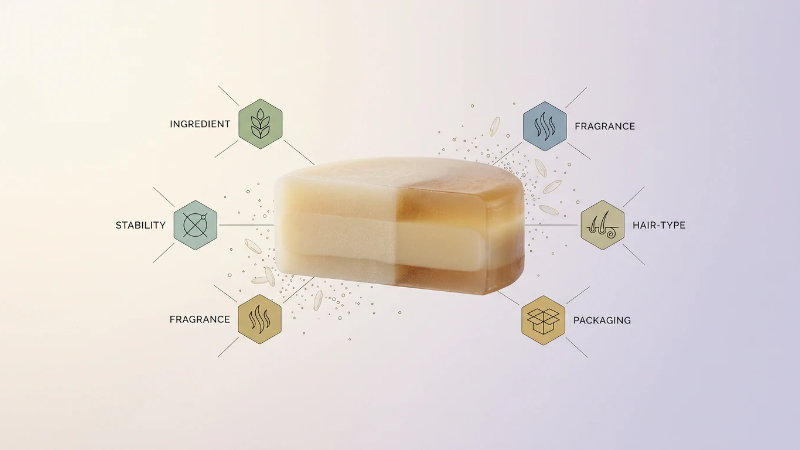
Facteur 1 : sélection des ingrédients — Là où l'histoire de l'eau de riz se joue ou s'effondre
C'est de loin l'ingrédient le plus mal compris. "L'eau de riz" n'est pas un ingrédient unique — c'est une catégorie, et chaque forme offre des propriétés différentes tout en présentant des enjeux réglementaires spécifiques.
Choisir votre véritable actif à base d'eau de riz (et pas seulement un terme marketing)
L'eau de riz fermentée est mon choix privilégié pour apporter brillance et glissant ; la fermentation rend ses actifs plus biodisponibles. La protéine de riz hydrolysée renforce la capacité filmogène, sur laquelle reposent concrètement les allégations de "renforcement".
L’inositol, la molécule dérivée du riz que l’on associe à la réparation, est puissant mais coûteux. J’adapte la forme à l’allégation que vous pouvez légalement étayer — jamais l’inverse.
La base tensioactive : élaborer un véritable pain de shampoing solide sans sulfates
Le système tensioactif détermine tout ce que le client ressent. Le SCI produit une mousse douce et crémeuse ; le SCS apporte dureté et longévité, mais doit être équilibré pour préserver la douceur.
Un véritable pain de shampoing solide sans sulfates est un choix de formulation, pas un slogan. Le mélange que je sélectionne modifie le coût, le toucher sur la peau et la durée de vie du pain lors d’une utilisation quotidienne.
Matrice de décision des ingrédients
| Composant de l’ingrédient | Fonction | Impact sur les coûts | Allégation qu’il soutient |
|---|---|---|---|
| Eau de riz fermentée | Brillance, douceur | Moyen | "Eau de riz fermentée" |
| Protéine de riz hydrolysée | Renforcement, filmogène | Moyen-Élevé | "Renforcement" |
| Inositol (dérivé du riz) | Soutien à la réparation | Élevé | "Réparation des dommages" |
| SCI (tensioactif) | Nettoyage doux | Moyen | "Sans sulfates" |
| SCS (tensioactif) | Dureté du pain, mousse | Faible | "Pain longue durée" |
Facteur 2 : stabilité de la formule — Le problème créé par l’eau de riz
C’est la leçon qui m’a coûté le plus d’efforts. Les actifs dérivés du riz peuvent rancir, changer de couleur ou favoriser la prolifération microbienne dans un pain utilisé sous l’eau. La stabilité est la section qui protège la réputation de votre marque.
Conservation d’un produit activé par l’eau
On pense souvent qu’un pain solide n’a pas besoin de conservateurs. Dès qu’il entre dans une douche humide, c’est pourtant le cas. Chaque cycle d’humidification favorise la prolifération microbienne sur tout nutriment à base de riz.
Je conçois une stratégie de conservation adaptée à une utilisation réelle, et non à des conditions de laboratoire où le pain reste sec et impeccable.
Prévenir le rancissement, l’évolution des odeurs et le changement de couleur
Les antioxydants et les agents chélatants sont indispensables dans ma formulation de pain de shampoing à l’eau de riz. Ils ralentissent l’oxydation, protègent l’intégrité du parfum et préservent cette teinte blanc cassé propre au lieu de la laisser virer au gris ou au jaune.
La dérive olfactive est subtile, mais fatale pour les avis — un pain qui sent bon au conditionnement, mais devient granuleux au sixième mois, sera retourné.
Mon protocole de test de stabilité avant la production en vrac
Avant d’augmenter la production d’un lot, je réalise un vieillissement accéléré, des cycles gel-dégel et des essais en conditions réelles sous la douche sur une durée de conservation projetée de 12–18 mois. Ces tests sont menés parallèlement à notre délai de production en vrac de 25–30 jours, afin de respecter des échéanciers réalistes.
Je préfère retarder un lancement de deux semaines plutôt que d’expédier un lot que je n'ai pas soumis à des tests rigoureux.

Facteur 3 : personnalisation du parfum — équilibrer le parfum avec une base naturellement "rizée"
Les actifs de riz présentent une légère note céréalière. Les amateurs essaient de la masquer ; je travaille avec elle.
Travailler avec la note de fond, et non contre elle
Les familles chaudes, crémeuses et gourmandes — lait de riz, vanille, avoine, bois de santal — complètent la base au lieu de créer un contraste. Les notes d’agrumes franches ou vertes ont tendance à accentuer l’odeur céréalière brute plutôt qu’à la masquer.
Choisir une famille qui s’harmonise avec la base nécessite un dosage de parfum moindre et reste plus propre au fil du temps.
Préférences naturelles, véganes et propres à chaque région
Les attentes olfactives varient fortement d’un marché à l’autre. Les acheteurs nord-américains privilégient souvent les profils doux et propres ; la distribution européenne s’oriente davantage vers des fragrances naturelles et discrètes ; les clients B2B du Moyen-Orient demandent fréquemment une intensité plus riche et plus persistante.
J’adapte à la fois le profil et le dosage à chaque région plutôt que d’expédier un parfum unique à l’échelle mondiale.
Conformité IFRA et déclaration des allergènes
Chaque parfum que je développe reste dans les limites de l’IFRA et respecte les règles régionales de déclaration des allergènes. La conception de parfums conformes n'est pas une formalité — c'est ce qui garantit que votre produit peut être vendu légalement sur trois continents.
Facteur 4 : ciblage par type de cheveux — Pourquoi "Pour tous les types de cheveux" est un positionnement peu convaincant
Voici mon point de vue à contre-courant : "pour tous les types de cheveux" fait chuter les conversions. Affiner votre cible rend votre message plus percutant et favorise les achats répétés.
Adapter la formule aux besoins des cheveux
Les cheveux fins, bouclés serrés, colorés et les cuirs chevelus sensibles nécessitent chacun une approche différente de la formulation. Un seul pain ne peut pas répondre efficacement à tous ces besoins — et prétendre le contraire favorise les avis mitigés.
Tableau de formulation par type de cheveux
| Segment cible | Accent de la formule | Additif recommandé | Angle de positionnement |
|---|---|---|---|
| Cheveux fins \/ gras | Conditionnement léger, clarifiant | Eau de riz + chélateur léger | "Volumisant" |
| Crépus \/ secs | Haute teneur en agents émollients | Protéines de riz + beurres | "Nutrition intense" |
| Cheveux colorés | pH équilibré, doux | Inositol + antioxydants | "Protection de la couleur" |
| Cuir chevelu sensible | Parfum léger | Actifs botaniques apaisants | "Respectueux du cuir chevelu" |
Le pH et la sensation après lavage comme facteurs déterminants de l’achat
La sensation après le rinçage détermine vos avis. Une sensation de propreté "qui crisse" peut être perçue comme desséchante par certains segments ; une sensation glissante et conditionnée rassure les autres.
J’ajuste le pH et la sensation après lavage en fonction du segment que vous ciblez, car cette première impression favorise le deuxième achat.
Facteur 5 : Options d’emballage — Le levier de conversion discret
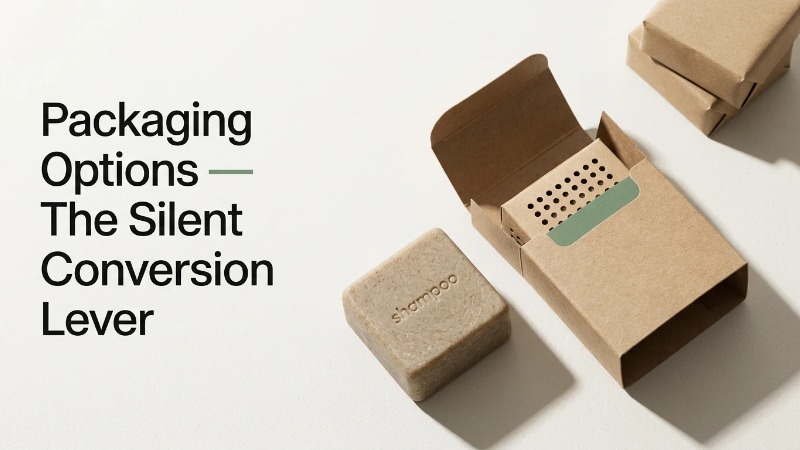
Je considère l’emballage personnalisé pour shampoing solide comme faisant partie intégrante de la formule, et non comme une réflexion après coup. Il protège le produit et porte sa promesse dans un même objet.
Protéger un produit sensible à l’humidité
L’emballage est directement lié aux risques de stabilité évoqués au facteur 2. Un produit qui doit sécher entre deux utilisations a besoin d’un étui aéré ; un produit vendu comme cadeau haut de gamme nécessite une protection rigide pendant le transport.
Les signaux de durabilité désormais attendus par les acheteurs
Les formats sans plastique, compostables et rechargeables ne sont plus facultatifs dans la distribution écoresponsable en Europe et en Amérique du Nord. Le bon signal de durabilité peut augmenter la conversion autant que la formule qu’il contient.
Comparaison des emballages personnalisés pour shampoing solide
| Type d’emballage | Niveau de protection | Attractivité en matière de durabilité | Adéquation au MOQ |
|---|---|---|---|
| Boîte kraft | Moyen | Élevé | Excellent (à partir de 1,000) |
| Boîte métallique | Élevé | Moyen-élevé | Bon |
| Emballage compostable | Faible à moyen | Très élevé | Excellent |
| Coffret cadeau rigide | Élevé | Moyen | Idéal pour le haut de gamme |
Aligner l’emballage sur votre stratégie de marque de distributeur
Les moules sur mesure, le gaufrage et les finitions d’impression donnent une forme concrète à l’identité de la marque. Une forme de barre distinctive ou un logo estampé en creux transforme un produit générique en un produit que les clients reconnaissent au premier coup d’œil.
Comment le bon partenaire de fabrication harmonise l’ensemble
Les cinq facteurs convergent vers une seule décision : avec qui vous développez votre produit. Un fabricant expérimenté de shampoings solides en marque blanche, doté d’une véritable capacité de fabrication OEM de soins capillaires naturels, est essentiel pour garder ces variables sous contrôle à grande échelle.
Chez Boymay, nous sommes spécialisés dans la fabrication OEM/ODM de produits de soins personnels depuis 1995, sur un site de 40,000 mètres carrés doté de 16 lignes de production automatisées et de plus de 200 employés.
Ce qu’il faut vérifier avant de vous engager
Demandez les certifications — nous détenons les certifications GMP, ISO, FDA et SMETA. Vérifiez les délais de traitement des échantillons et confirmez la flexibilité du MOQ, car ces deux paramètres structurent l’ensemble de votre calendrier de lancement.
Pourquoi les délais d’échantillonnage sont importants pour votre lancement
Des attentes réalistes protègent votre feuille de route. Nous préparons des échantillons personnalisés en 7–14 jours selon la formule, le parfum, l’apparence et l’emballage, avec une production en volume en 25–30 jours. Notre MOQ commence à seulement 1,000 unités.
Prêt à passer du concept à un shampoing solide que vos clients rachèteront
Vous n’avez pas besoin d’un autre shampoing solide générique. Il vous en faut un conçu pour résister à la douche, répondre aux attentes d’une clientèle spécifique et inciter à un deuxième achat.
Construisons-le ensemble. Demandez un échantillon personnalisé et une consultation sur la formulation, et mettez notre site certifié ainsi que notre expertise OEM/ODM depuis 1995 au service de votre shampoing solide à l’eau de riz.
Lancez dès aujourd’hui votre projet de shampoing solide à l’eau de riz en marque blanche avec Boymay — contactez-nous pour obtenir votre échantillon personnalisé et transformons votre concept en un shampoing solide que vos clients voudront racheter.
Questions fréquemment posées
Un shampoing solide à l’eau de riz peut-il être entièrement végan et sans cruauté envers les animaux ?
Oui. Nous formulons des barres véganes à partir d’actifs dérivés du riz et d’origine végétale, et nos produits ne sont jamais testés sur les animaux. L’histoire de l’eau de riz s’inscrit naturellement dans un positionnement propre et axé sur les plantes.
Quel est le minimum de commande réaliste pour lancer une gamme en marque blanche ?
Notre quantité minimale de commande est de 1,000 unités. Ce faible seuil d’entrée permet aux marques émergentes de tester un marché ou de lancer un nouveau segment sans prendre le risque d’une première production massive.
Combien de temps les barres de shampoing à l’eau de riz restent-elles stables ?
Avec une stratégie adaptée d’antioxydants, d’agents chélatants et de conservation, nous visons une durée de conservation de 12–18 mois. Chaque formule est soumise à des tests de vieillissement accéléré, de cycles gel-dégel et à des essais en conditions réelles sous la douche avant de passer à la production en vrac.
Puis-je demander un parfum et un moule personnalisés ?
Absolument. Nous proposons un haut niveau de personnalisation, notamment des moules sur mesure, du gaufrage et le développement de parfums exclusifs adaptés à votre région cible et à votre segment de type de cheveux.
Comment formuler légalement des allégations sans sulfates ?
Une allégation « sans sulfates » repose sur le choix des tensioactifs — en utilisant des systèmes tels que le SCI et des co-tensioactifs doux plutôt que le SLS ou le SLES. Nous documentons la base des ingrédients afin que votre allégation soit étayée et défendable.