
Parcourez aujourd'hui le rayon des soins personnels et vous remarquerez une évolution. À côté des flacons en plastique habituels, de petites boîtes métalliques et des sachets en papier contenant du shampoing solide commencent à faire leur apparition. Parmi les nouveautés les plus récentes : les shampoings en comprimés, des disques compacts de nettoyant concentré qui se dissolvent en mousse dès qu'ils entrent en contact avec des cheveux mouillés.
Ils s'inscrivent dans une tendance plus large vers les soins capillaires sans eau et gagnent rapidement du terrain. Ce guide explique ce qu'ils sont, comment les utiliser correctement, comment ils sont réellement fabriqués et pourquoi cette catégorie suscite un vif intérêt auprès des marques et des distributeurs à l'approche de 2026.
Que sont les shampoings en comprimés ?
Un shampoing en comprimé est essentiellement votre shampoing habituel dont l'eau a été retirée, les ingrédients restants étant compressés sous une forme solide et compacte. Ajoutez de l'humidité pendant votre douche et il se transforme à nouveau en mousse.
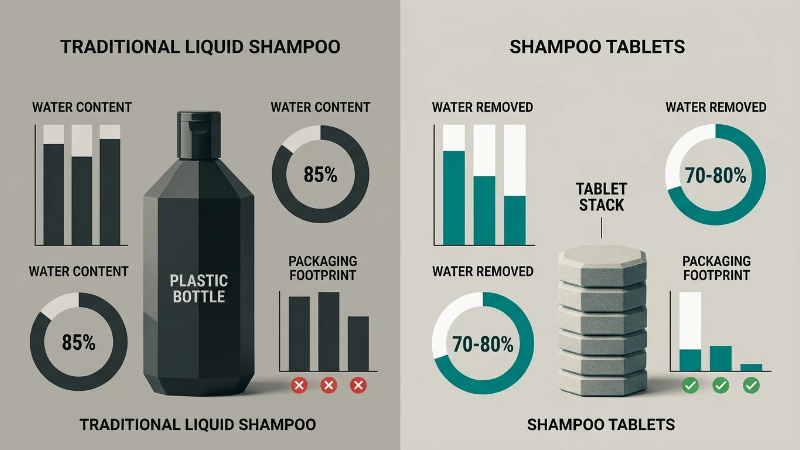
Comme l'eau représente souvent 70–80% d'un shampoing en bouteille, son retrait permet d'expédier un produit plus léger et plus compact. Ce simple changement a des répercussions sur l'emballage, les émissions liées au transport et la durée de conservation.
La différence entre les tablettes, les pains et le shampooing liquide
Le shampooing liquide est l’option familière : pratique, mais lourd et conditionné dans du plastique. Les pains de shampooing, qui existent depuis plus longtemps, sont généralement fabriqués en coulant ou en moulant à la main une base semblable à du savon.
Les tablettes sont les nouvelles venues distinctives. Elles sont produites par compression, de manière similaire à la fabrication d’une pastille de vitamines ou de lave-vaisselle. Cette précision confère à chaque unité un dosage constant et une texture plus ferme et moins friable que celle de nombreux pains moulés à la main.
Pourquoi les soins capillaires sans eau sont tendance
Trois raisons pratiques expliquent leur attrait. Premièrement, l’absence de liquide signifie qu’il n’y a pas de flacons susceptibles de fuir et facilite les déplacements—un avantage pratique compte tenu des règles applicables aux bagages cabine des compagnies aériennes. Deuxièmement, l’empreinte liée à l’emballage diminue considérablement. Troisièmement, un format concentré dure souvent plus longtemps que prévu, ce qui séduit les consommateurs attentifs au rapport qualité-prix.
Comment utiliser les tablettes de shampooing
La prise en main est rapide, mais quelques habitudes font une réelle différence sur le résultat.
Étape 1 : Mouillez vos cheveux et la tablette
Imprégnez soigneusement vos cheveux d’eau, puis passez brièvement la tablette sous l’eau. Il suffit de l’humidifier rapidement—inutile de la laisser dégouliner. Sa surface commence presque immédiatement à s’assouplir.
Étape 2 : Faites mousser et massez
Frottez la tablette entre vos paumes ou directement sur votre cuir chevelu jusqu’à ce qu’elle commence à mousser. Répartissez ensuite la mousse dans vos cheveux du bout des doigts, en vous concentrant sur les racines, où le sébum s’accumule.
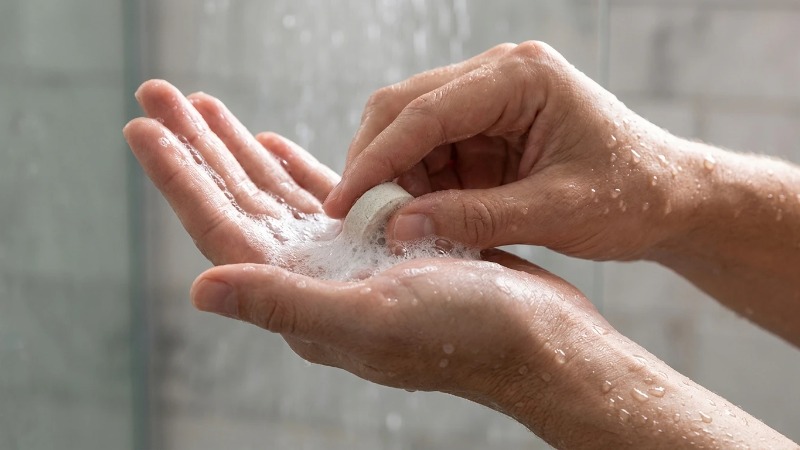
Étape 3 : Rincez et répétez si nécessaire
Rincez abondamment. Les cheveux épais ou longs peuvent bénéficier d’un second passage plus léger. Les cheveux fins n’en nécessitent généralement qu’un seul. Appliquez ensuite un après-shampooing si cela fait partie de votre routine.
Erreurs courantes à éviter
La plus importante concerne le rangement. Laisser une tablette dans une flaque d’eau sur le rebord de la douche réduit sa durée de vie. Entre deux utilisations, conservez-la sur un porte-savon égouttoir, dans un endroit sec.
La deuxième consiste à utiliser une dose excessive—les personnes habituées à presser une généreuse noisette de liquide ont tendance à utiliser trop de produit. Commencez par une petite quantité ; elle est plus efficace que vous ne le pensez.
Comment fabriquer des tablettes de shampooing : le processus de base
À la base, la production de tablettes consiste à mélanger des ingrédients nettoyants secs afin d’obtenir une poudre homogène, puis à comprimer cette poudre sous haute pression pour former un disque solide. Le principe est simple, mais sa mise en pratique exige de la précision.
Les principaux ingrédients dont vous aurez besoin
Une formule efficace nécessite un tensioactif nettoyant, des liants pour maintenir la forme, ainsi que des additifs pour le soin, le parfum et l’apparence. L’équilibre entre ces éléments détermine si la tablette mousse correctement, offre une sensation agréable et ne s’effrite pas.
Tensioactif Sodium Cocoyl Isethionate
Le Sodium Cocoyl Isethionate, souvent abrégé en SCI, est un tensioactif dérivé de la noix de coco privilégié dans les formulations de soins capillaires sans eau. Il est véritablement doux—bien plus doux que les sulfates courants dans les anciens shampooings—tout en produisant une mousse riche et crémeuse.
Comme il se présente sous une forme solide à faible teneur en humidité, le SCI convient parfaitement aux produits compressés. Pour ces raisons, c’est un ingrédient polyvalent de nombreuses formules solides de qualité.
Liants, parfums et agents revitalisants
Les liants, tels que certains amidons ou poudres d’origine végétale, aident le comprimé à rester intact lors de sa manipulation. Les agents conditionnants—comme le behentrimonium methosulfate ou le panthénol—compensent la sécheresse que le nettoyage seul peut provoquer.
Le parfum et les acides doux servant à ajuster le pH complètent la formulation. C’est dans le dosage des proportions que les formules amateurs et professionnelles tendent à diverger.
Une recette simple de shampoing solide en barre comparée à une formulation en comprimé
Une recette de base de shampoing solide fait maison peut consister à faire fondre une base SCI, à incorporer des huiles et du parfum, puis à presser le mélange à la main dans un moule en silicone et à le laisser durcir pendant quelques jours.
La formulation en comprimé est plus rigoureuse. Les ingrédients sont pesés avec des tolérances très strictes, mélangés sous forme de granulés contrôlés, puis compressés à la machine. L’objectif est d’assurer l’uniformité du dosage—chaque comprimé du lot doit se comporter de la même manière—ce que le moulage manuel ne peut pas garantir de façon fiable.
La méthode de moulage par compression des comprimés de shampoing
La méthode de moulage par compression des comprimés de shampoing est le procédé industriel, et elle explique pourquoi les comprimés fabriqués en usine sont si uniformes.
Mélange et granulation
Les composants secs sont mélangés, puis granulés—souvent avec une petite quantité de liant liquide—afin que la poudre s’écoule uniformément et se comprime proprement. Une mauvaise granulation est l’une des principales causes de comprimés mous et friables.
Compression et moulage
Les granulés sont acheminés vers une presse à comprimés, où des poinçons les compriment sous une pression importante pour leur donner une forme définie. Les moules personnalisés permettent aux fabricants de produire différentes tailles et épaisseurs, et même d’y estampiller des logos en relief.
Séchage et contrôle qualité
Après la compression, les comprimés peuvent être séchés et durcis afin d’être stabilisés. Les contrôles qualité portent sur la dureté, la variation de poids, la teneur en humidité et la vitesse de dissolution du comprimé. Ces mesures préservent à la fois les performances et la durée de conservation.
Fabrication maison ou professionnelle
Fabriquer quelques comprimés à la maison pour un usage personnel est tout à fait possible. En fabriquer des milliers qui soient sûrs, stables et identiques représente un défi tout autre.
Limites des comprimés fabriqués maison
Les productions réalisées en cuisine manquent de régularité—un comprimé mousse parfaitement, tandis que le suivant s’effrite. Sans contrôle de la pression et de l’humidité, la stabilité pendant la conservation est imprévisible. De plus, il est difficile de garantir, en dehors d’un site de production adapté, les normes d’hygiène indispensables pour un produit en contact avec la peau.
Pourquoi les marques choisissent des partenaires OEM\/ODM professionnels
Les marques qui souhaitent réellement commercialiser des comprimés de shampooing travaillent presque toujours avec un fabricant OEM\/ODM certifié. Cela élimine les incertitudes liées à la formulation, à la conformité et à la qualité constante, tout en permettant au fondateur de se concentrer sur l’image de marque plutôt que sur les machines.
Le marché en pleine croissance des comprimés de shampooing
Le segment plus large des cosmétiques solides et sans eau s’est développé régulièrement, porté par les préoccupations liées au développement durable et par les engagements de nombreux distributeurs en faveur de la réduction du plastique. Les analystes qui suivent les cosmétiques solides jusqu’au milieu des années 2020 continuent de prévoir une croissance à deux chiffres pour cette catégorie.
La demande des consommateurs pour des produits durables
Les consommateurs—en particulier en Amérique du Nord et en Europe—consultent de plus en plus les étiquettes à la recherche de mentions telles que "sans plastique" et "végan". La pression réglementaire exercée par l’UE sur les plastiques à usage unique a également incité les marques à adopter des formats concentrés nécessitant peu d’emballage. Les comprimés de shampooing se situent précisément à cette intersection.
Opportunités pour les marques et les distributeurs
Comme le format est encore relativement récent, les nouveaux acteurs ont la possibilité de s’implanter avant que les rayons ne soient saturés. Un parfum distinctif, une formule propre et un emballage bien pensé peuvent permettre de se tailler une véritable niche alors que la curiosité des consommateurs est à son comble.
S’associer à Boymay pour votre gamme de shampooings solides en tablette
Transformer une idée en produit prêt à être commercialisé est précisément là qu’un partenaire de fabrication démontre sa valeur. Boymay se concentre sur les soins personnels depuis 1995 et possède une solide expérience dans les éponges de bain, les gels douche et les produits connexes sous marque de distributeur.
Nos capacités de fabrication
Boymay exploite une usine de 40,000 m² équipée de 16 lignes de production automatisées et s’appuie sur une équipe de plus de 200 personnes. Cette capacité permet d’assurer une production régulière sans sacrifier l’attention que nécessitent les projets personnalisés.
Certifications et assurance qualité
La production est encadrée par les certifications GMP, ISO, FDA et SMETA. Pour les acheteurs B2B en Amérique du Nord, en Europe et au Moyen-Orient, ces normes se traduisent par une documentation complète et une régularité attendue par les partenaires de la grande distribution.
Options de personnalisation
Moules personnalisés, fragrances sur mesure et emballages adaptés sont tous envisageables. Les formules peuvent être développées selon des critères vegan et ne sont jamais testées sur les animaux—un argument de vente de plus en plus important pour les consommateurs engagés.
Faible MOQ et délais fiables
La quantité minimale de commande commence à 1,000 unités, ce qui réduit la barrière à l’entrée pour les marques émergentes. Les échantillons personnalisés sont généralement prêts sous 7–14 jours selon la formule, le parfum et l’emballage, tandis que la production en volume nécessite 25–30 jours.
Conclusion : se lancer dans les shampooings solides en tablette
Les shampooings en comprimés réunissent trois éléments que les consommateurs recherchent de plus en plus : la commodité, une réduction du plastique et un produit performant. Pour les utilisateurs, la routine est simple dès lors que le dosage est correctement maîtrisé.
Pour les marques, le moment est favorable—la catégorie est encore récente, la demande augmente et le processus de fabrication est bien établi. Si vous envisagez de créer votre propre gamme, l’expérience, les certifications et le faible seuil d’entrée de Boymay en font un interlocuteur pratique pour entamer les échanges.
Foire aux questions
Q : Les shampooings en comprimés conviennent-ils à tous les types de cheveux ?
R : Oui, lorsque la formule est adaptée aux besoins. Les versions plus douces et plus revitalisantes conviennent aux cheveux secs ou colorés, tandis que les formules clarifiantes plus légères sont adaptées aux cheveux gras ou fins. La flexibilité de formulation est précisément la raison pour laquelle la fabrication sur mesure est importante.
Q : Combien de temps dure un shampooing en comprimé ?
R : Un seul comprimé couvre généralement une à deux utilisations, selon la longueur des cheveux et la quantité utilisée. Comme le produit est concentré, la plupart des utilisateurs constatent qu’un paquet dure plus longtemps que prévu.
Q : Les shampooings en comprimés sont-ils meilleurs pour l’environnement ?
R : Ils nécessitent généralement beaucoup moins d’emballages en plastique et, étant sans eau, sont plus légers à expédier—ce qui réduit les émissions liées au transport. Ils permettent également de ne pas transporter l’eau présente dans chaque flacon. Cette combinaison explique en grande partie leur attrait.
Q : Puis-je créer ma propre marque de shampooings en comprimés en marque blanche ?
R : Absolument. En collaborant avec un fabricant OEM/ODM comme Boymay, vous pouvez développer une formule personnalisée, choisir votre parfum et votre emballage, puis commercialiser le produit sous votre propre marque sans devoir construire vous-même une usine.
Q : Quelle est la quantité minimale de commande pour commencer ?
A : Le MOQ de Boymay commence à 1,000 unités, ce qui permet aux marques plus petites et plus récentes de tester le marché avant de s’engager sur des séries plus importantes.